

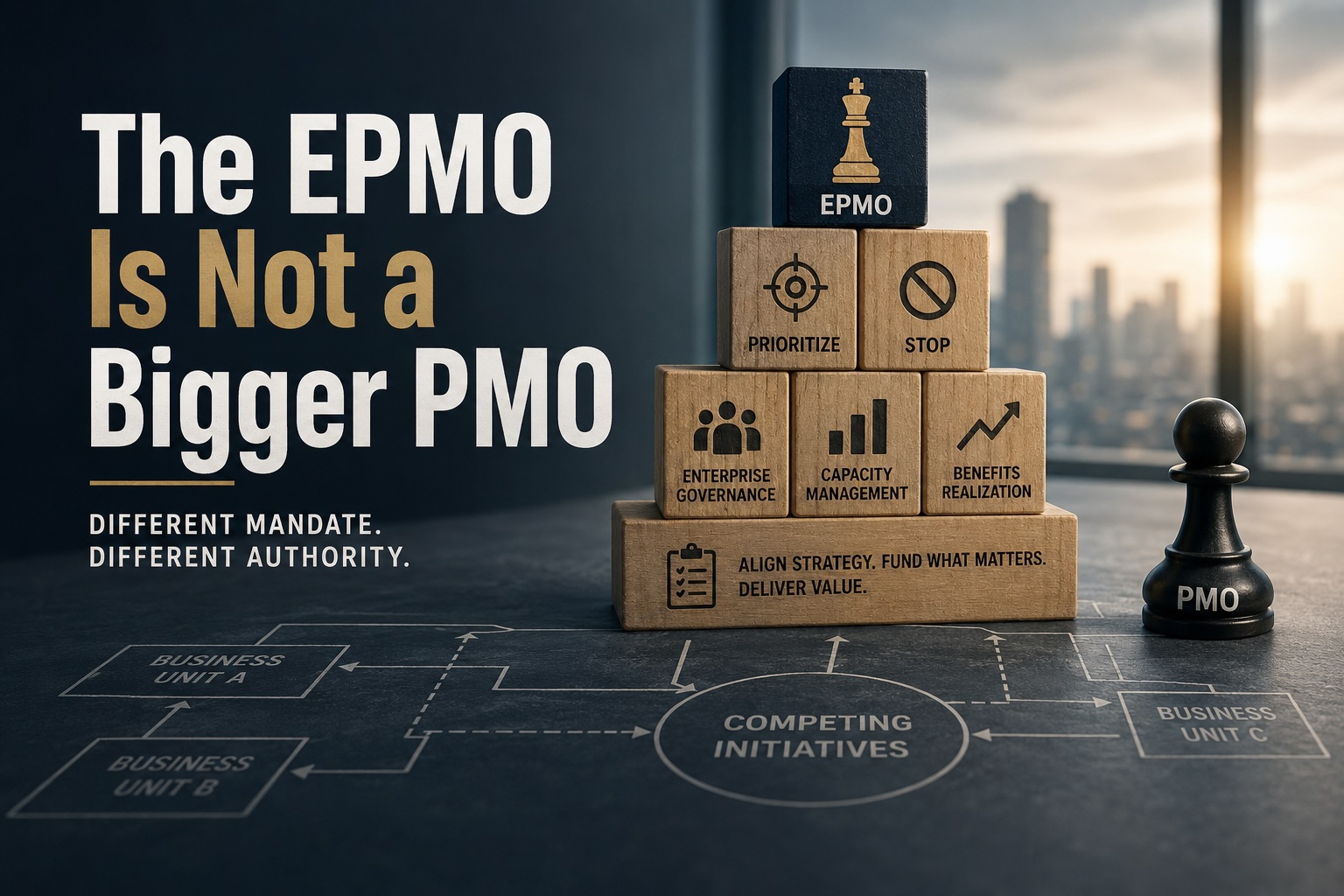
There is a simple test that tells you whether you are looking at an enterprise PMO, and it takes one question.
Who decides what does not get done?
If the answer is a business unit head, a functional director, or “it depends who pushes hardest,” you are looking at a PMO — possibly a very good one. If the answer is a body that sits above all business units, meets on a fixed cadence, and can stop a funded initiative that a divisional executive still wants, you are looking at something else. The label on the door is usually the least reliable indicator.
I spend most of my working life inside this distinction, and it is worth being precise about it, because the term Enterprise PMO is now applied to almost anything with the word “global” in its remit.
Two taxonomies that get quietly merged
Most confusion around the EPMO comes from collapsing two separate classifications into one hierarchy.
The first is about degree of control. The PMBOK Guide (6th edition) distinguishes supportive PMOs, which provide templates, training and lessons learned and exercise low control; controlling PMOs, which require compliance with defined frameworks and exercise moderate control; and directive PMOs, which take control by managing the projects directly. This is a spectrum of authority over how work is executed.
The second is about position and scope. PMI’s PMO Frameworks report (2013) identifies five types found in practice: the project-specific PMO or project office; the project support, services or controls office; the organizational unit, business unit or departmental PMO; the Center of Excellence or Center of Competency; and the Enterprise / Organization-wide / Strategic / Corporate / Portfolio / Global PMO. The last of these is described as the highest-level PMO in organizations that have one, responsible for aligning project and program work to corporate strategy, establishing enterprise governance, and performing portfolio management to ensure strategy alignment and benefits realization.
These are different axes. A directive PMO can perfectly well be departmental — a manufacturing site office that owns its project managers and runs their projects for them. And an EPMO is frequently not directive: it rarely manages projects itself. Its authority is exercised over what enters the portfolio, what is funded, what is stopped, and what gets reported to the board. Calling an EPMO “the directive one” is a category error, and it leads organizations to design the wrong thing — a heavier delivery machine when what they needed was a decision body.
The European counterpart is worth knowing, because it makes the structural point more explicit. Axelos’ P3O model describes a hub-and-spoke arrangement in which a permanent Portfolio Office sits at the centre, while programme and project offices are temporary and dissolve with the work they support. The permanence is the tell. Enterprise-level offices do not close when a program closes.
The lower forms, briefly
The project office exists for one large project or program. It is temporary by design, staffed for the duration, and dies with the initiative. It handles planning, scheduling, risk logs, and reporting for a single scope. Nothing about it is strategic, and nothing should be.
The project support or controls office provides delivery mechanics across several projects: scheduling, cost control, document management, tooling administration. It is a service function. It does not decide what runs; it makes what runs auditable.
The departmental or business unit PMO is the most common form — the PMO Frameworks research found it present in the majority of organizations. It supports a division: IT, engineering, operations, supply chain. It typically holds a local portfolio, a local methodology, and a local set of project managers. Its horizon ends at the boundary of its unit, and so does its ability to arbitrate. When two divisions compete for the same three data architects, a departmental PMO can describe the conflict but cannot resolve it.
The Center of Excellence is a capability function. It owns methodology, standards, tooling, training, career paths, and quality assurance for the profession. It raises the average competence of delivery without owning any delivery. Gerald Hill’s competency continuum in The Complete Project Management Office Handbook places it at the top of a five-stage progression running from Project Office through Basic, Standard and Advanced PMO to Center of Excellence — a useful model, though it describes maturity of capability rather than position in the hierarchy.
Each of these is legitimate. Each answers a real need. None of them is an EPMO, and none of them becomes one by adding headcount.
What actually changes at enterprise level
The EPMO’s unit of work is not the project. It is the set of commitments the organization has made, considered against the capacity it actually has.
That shift produces a specific list of responsibilities. The EPMO owns the intake gate for anything above a defined threshold, so that initiatives enter through evaluation rather than through narrative. It maintains the single authoritative inventory of what is running — the number that finance, the PMO, and the functional heads normally disagree about. It runs prioritization across units, which means it must be able to rank a supply chain program against a commercial system replacement using comparable criteria. It manages enterprise capacity, which the Standard for Portfolio Management treats as a performance domain in its own right, alongside strategic management, governance, value and risk. It owns benefits realization past handover. And it produces the reporting that the executive committee and the board actually steer with.
Two features distinguish this from a large departmental PMO more reliably than anything else.
The first is the authority to stop. Not to recommend stopping — to stop. An office that can only escalate is a reporting function with an enterprise-sized mailing list.
The second is reporting line and cadence. An EPMO reports to the CEO, CFO, COO or the executive committee, and it has a standing slot in a decision forum that meets whether or not there is a crisis. If the portfolio review happens when someone remembers to call it, the portfolio is not being governed.
Where the Strategy Office element comes from
Your instinct that an EPMO carries Strategy Office DNA is well founded, and it has a documented origin.
In 2005 Robert Kaplan and David Norton published The Office of Strategy Management in Harvard Business Review, arguing that strategy execution fails not for lack of a strategy but for lack of an organizational owner of the execution process. Their proposal was a small executive-level unit responsible for the strategy management cycle: translating strategy into objectives, aligning units and initiatives to it, running the strategy review meeting, and communicating strategy across the organization. Crucially, they placed initiative management inside that office’s remit — the same initiative portfolio the EPMO governs.
Antonio Nieto-Rodriguez makes the operational version of the same argument in The Focused Organization and later work: strategy becomes real at the moment resources are committed to something specific. Before that it is intent. If that is true, then the body that decides which initiatives get funded and staffed is, functionally, executing strategy — whatever it is called on the org chart.
In practice I see three settlements. Some organizations run an OSM and an EPMO separately, with a permanent seam between them where strategic intent meets execution capacity. Some fold strategy management into the EPMO, which then owns the cascade from strategic objectives to initiatives to benefits. And some run a Chief Transformation Officer or Chief Project Officer construct in which the EPMO is the operating arm. All three work. The pathological case is the fourth: a strategy team that defines objectives and an EPMO that tracks projects, with no mechanism connecting them, and an annual planning exercise pretending to be one.
Who actually works there
The most common design error when standing up an EPMO is to staff it with more project managers. That produces a large delivery office, not a governing one.
The PMI survey data shows the composition difference clearly. Across the five frameworks, EPMOs reported the highest proportion of PMP credential holders among their project managers — 55 percent, against a study average of 43 percent — and the lowest proportion of contract employees, 44 percent against an average of 49 percent. Enterprise offices hire permanent, credentialed, institutionally embedded people. That is consistent with the nature of the work: intake gates, prioritization criteria and benefits baselines are institutional assets, not surge capacity.
The role taxonomy that describes this best comes from Axelos’ P3O, which splits offices into management roles, generic roles, and functional roles. Translated into what an enterprise office in an industrial or multi-unit organization actually needs, six profiles recur.
The head of the EPMO. An executive, not a senior project manager. The job is largely political: holding the intake gate against senior pressure, chairing or preparing the portfolio decision forum, and maintaining credibility with functional leaders who did not ask for this office to exist. If this person cannot comfortably disagree with a divisional VP in front of the CEO, the office will not function regardless of how it is designed.
The portfolio analyst. In P3O this is a named generic role, and in practice it is the spine of the whole operation. This person owns the data model: what an initiative is, what states it can be in, how cost and effort are captured, how the numbers reconcile with finance. Every EPMO I have seen fail in its first year failed here — the office produced views nobody trusted, and the argument shifted permanently from decisions to data quality.
The governance and reporting lead. Owns the meeting architecture, the pack, the escalation path, and the minutes that record what was actually decided. Unglamorous and disproportionately determinative of whether decisions stick.
The benefits and value role. P3O names it explicitly, and PMI’s portfolio domain includes benefits realization tracking. This is the role most often skipped, and its absence is why benefits tracking is usually abandoned about four months after handover.
The methodology and tooling owner. Methodology definition is a routine service for 80 percent of EPMOs in the PMI data — the highest across all five frameworks. Someone owns the standards, the templates, the stage gates, and the PPM tool configuration. In larger organizations this may sit in a separate Center of Excellence; in mid-sized ones it sits inside the EPMO.
The change and stakeholder role. An EPMO is itself an organizational change, imposed on units that previously arbitrated their own priorities. Treating adoption as a communication afterthought is the single most reliable way to be resented.
Two observations from practice. First, in a mid-sized organization these six profiles are rarely six people — four to six staff covering all of them is normal, and workable. What is not workable is collapsing all of them onto the head of the EPMO, which is the default when the office is created without a real budget. Second, note who is not on this list: the project and program managers themselves. In a well-designed enterprise office they remain in the business units, close to the work and the sponsors. The EPMO governs their portfolio; it does not usually employ them.
What it does on an ordinary Tuesday
Governance sounds abstract until you look at the calendar. An EPMO’s real product is a decision cadence, and the cadence has four layers.
Weekly is exception handling. The intake queue is triaged — what arrived, what is complete enough to evaluate, what goes back. Escalations from programs are resolved or routed. Resource conflicts surface here first, usually as two program managers wanting the same specialist in the same fortnight. Nothing strategic happens in a weekly cycle; what happens is that small problems are prevented from becoming portfolio problems.
Monthly is the portfolio review. Status against baseline, forecast against approved envelope, stage-gate decisions on initiatives reaching a boundary, and a first look at benefits on things already delivered. PMI’s data shows this is the dominant rhythm: 40 percent of EPMOs report on a monthly cycle and 30 percent weekly.
Quarterly is where the office earns its existence. Re-prioritization against current strategy, capacity re-baselining against what the organization can actually staff, and explicit stop, pause or continue decisions on initiatives that are no longer justified. This is also when the board or executive committee pack is built around portfolio health rather than project status.
Annually the EPMO plugs into the planning cycle — ideally before objectives are finalized rather than after. PMI’s research found EPMOs report the highest involvement of any PMO type in the upstream phases of strategic management: 58 percent routinely involved in aligning projects with strategic objectives, 57 percent in identification and prioritization, and 41 percent in strategy formulation itself.
Between those meetings sits the majority of the work, and it is not glamorous. Chasing data quality so that the next review is about decisions rather than numbers. Sitting with sponsors individually before a decision, because portfolio meetings ratify agreements, they rarely create them. Coaching program managers whose reporting is optimistic rather than dishonest, which is a harder conversation. Arbitrating in corridors. Writing down what was decided so that it cannot be relitigated in six weeks.
One honest note from the same PMI data, because it is worth knowing before anyone builds one. EPMOs did not show the best delivery statistics of the five frameworks. They reported the lowest share of high performers — 15 percent, against 19 percent overall — and the lowest percentage of projects meeting original goals, 66 percent against a 69 percent average. Two readings are plausible and both are probably true: enterprise offices are handed the hardest, most cross-functional, most politically contested work, and many of them are enterprise in name while still spending their days on delivery mechanics. The same survey shows 73 percent of EPMOs routinely performing schedule, cost and scope management. That is not what an enterprise office is for. It is what an enterprise office drifts into when the governing mandate turns out to be thinner than the job title.
Which organizations it fits — and which it does not
An EPMO is expensive, politically exposed, and slow to earn credibility. It is justified by a specific set of conditions, not by size alone.
It works where multiple units compete for the same scarce resources — capital, data owners, ERP specialists, validation capacity, engineering hours. Cross-unit arbitration is the EPMO’s core product, and where nothing needs arbitrating there is nothing to sell.
It works where the change agenda is large relative to the operating base: post-merger integration, ERP or S/4HANA transformation, footprint restructuring, greenfield industrial build-out, regulatory programs with hard external deadlines. In these environments the portfolio is not a subset of what the organization does; for a period, it is most of what the organization does.
It works particularly well in joint ventures and multi-owner structures, where two parent organizations bring different governance conventions, different reporting expectations, and different definitions of done. An enterprise-level office is often the only neutral place where a single version of progress can exist.
It works where capital allocation and initiative selection are genuinely contested — which usually means capital-intensive industry, or a company under financial pressure where the stop decision has real consequences.
It does not work well in a single-business-unit company with a coherent management team, where the executive committee already performs portfolio arbitration informally and faster than any office would. It does not work where basic delivery discipline is absent: if projects have no baselines, no named sponsors, and no acceptance criteria, an enterprise office will spend two years building foundations while being judged on strategic impact, and will lose. And it does not work where the executive team wants visibility but not accountability — an EPMO given reporting duties without decision rights becomes a slide factory, and is correctly resented as bureaucracy. That gap between reporting duties and decision rights is exactly what a mandate charter exists to close — for a PMO or an EPMO alike.
That last failure mode is not rare. Brian Hobbs and Monique Aubry’s survey of 500 PMOs found that roughly half reported having their legitimacy seriously questioned, and that PMOs were being shut down or radically restructured almost as fast as they were being created. Enterprise-level offices are not exempt from this. They are more exposed to it, because they are more visible and they say no more often.
The counterweight is that when the mandate is real, the effect is measurable. PMI’s Pulse of the Profession (2017) reported that organizations aligning their EPMO to strategy saw 38 percent more projects meet their original goals and business intent, and 33 percent fewer projects deemed failures. The same research found that among organizations with a PMO, about half had an EPMO. The differentiator in that data is not the existence of the office. It is the alignment.
A recognition checklist
Ten questions. They are deliberately binary, and they are about observable facts rather than charters. Count the yeses.
- Does the office report to the CEO, CFO, COO or the executive committee — not to a functional head?
- Does it hold a single authoritative list of all initiatives above a defined threshold, across every business unit?
- Is there a formal intake gate, and has something been refused entry in the last six months?
- Can it stop or pause a funded initiative, rather than only recommend it? Name the last time it did.
- Does prioritization produce an ordered list, rather than tiers in which everything eventually becomes tier one?
- Is enterprise capacity — named people, not FTE averages — an explicit constraint in the funding decision?
- Does the portfolio review meet on a fixed calendar regardless of whether there is a crisis?
- Are benefits tracked after handover, by a named owner, against a baseline recorded before approval?
- Is the office involved in the strategic planning cycle before objectives are finalized, rather than after?
- Does the board or executive committee steer using the office’s reporting, or does it maintain a parallel set of numbers?
Eight or more: you have an EPMO. Four to seven: you have a strategic PMO with an incomplete mandate — the most common and most frustrating position, and usually a mandate problem rather than a capability problem. Three or fewer: you have a departmental or support PMO wearing an enterprise title, and the gap between the title and the authority will be blamed on the office rather than on the design.
Question four carries more weight than the others combined. Every function can be given a scope. Only a governing one can be given a veto.
The distinction that matters
The difference between a PMO and an EPMO is not scale, seniority, or the number of business units in the reporting pack. It is the class of decision the office is trusted to make.
A PMO answers whether the work is being done well. An EPMO answers whether it should be done at all, whether the organization can afford it in people rather than in budget lines, and whether the value used to justify it ever arrived.
Organizations that want the second answer while granting only the first authority will get neither. They will get reports.