


On a Monday morning the PMO sends a short message to every project leader in the organisation. Three possible dates for a community catch-up, one click to choose, a deadline a week away. Nothing to prepare, nothing to read.
A week later, the list of names that never clicked is long enough to count as a finding. Two reminders have gone out. Nobody has proposed a fourth date either. Several of the silent names lead projects that sit on the portfolio list, visible and running.
What disqualifies a project leader in 2027 is not a lack of AI skills but two older failures: zero responsiveness, and passive waiting for someone else to move first.
A one-click request is the cheapest leadership test you will ever run
The debate about digital skills for project leaders has moved on to agents, copilots and prompt libraries. Meanwhile, the failure that actually stalls projects sits several floors lower. The question is not who can build an agent. It is who answers a message.
A scheduling poll makes a clean test precisely because it removes every excuse. There is no content to understand, no risk in getting it wrong, nothing to prepare. It measures one thing only: whether a request that reaches a person turns into a response within a reasonable time.
That loop is project control in miniature. A sponsor’s decision needs confirming. A risk owner needs to update an entry. A supplier’s escalation needs an acknowledgement before Thursday. Each is a request that someone has to receive, answer, turn into a commitment and then close. If the loop breaks on a poll with nothing at stake, it will break on a decision with real money attached.
Silence diagnoses the appointment as often as the person
Before anyone draws conclusions about individuals, look at who the silent names are. In most organisations, many project leaders are not project managers by job title. They run a department, a production area or a function, and they lead a project on top of it. This is the familiar pattern of accidental project managers, and for many of them the project is real, visible and running.
So silence has two possible readings. The first is capability: the person does not run their inbox, calendar and chat as working tools, and requests simply fall through. The second is capacity: the person can do all of it, but the organisation added the project to a full line role without taking a single hour away. The title was handed over. The time was not.
Both are appointment errors, and they need opposite fixes. A capability gap calls for a different leader, or for a short, explicit baseline before the project starts. A capacity gap calls for a decision by the sponsor and the line manager about what the person stops doing. Treating the second as the first, by sending an overloaded department head on a digital skills course, fixes nothing and costs goodwill.
Either way, the conclusion for the role is the same. A leader who does not respond, whatever the reason, cannot lead the project as it is currently set up. The cause decides the remedy. It does not change the verdict.
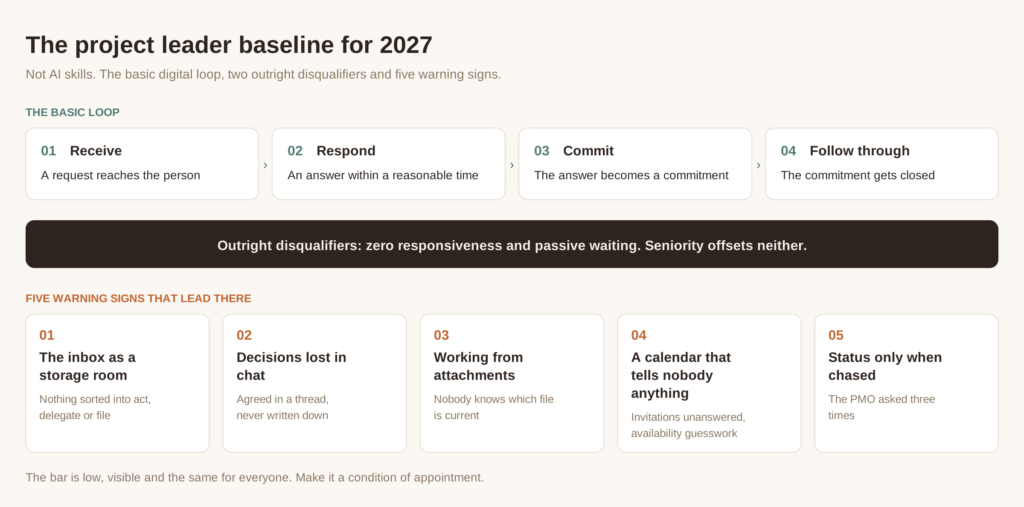
Two failures disqualify outright, and five habits warn you first
Zero responsiveness is the first disqualifier that needs no weighing. A project leader who lets requests vanish without an answer, week after week, is not leading anything.
Passivity is the second. A leader who waits for the PMO to chase, for the sponsor to ask, or for a problem to become someone else’s has the loop running backwards. A project needs someone who sends the first message: raises the risk before it lands, asks for the decision before the deadline, proposes the date instead of waiting for the poll. A leader who only reacts, however promptly, turns the project into a queue of other people’s requests.
Seniority, expertise and goodwill offset neither failure, because every other part of the role depends on both directions of the loop.
Most people do not arrive there in one step. They drift towards it through habits that are universal and older than any technology: no personal planning, no sense of priority, no habit of closing what was opened. Digital habits are simply where those gaps now show first. Five are worth naming, because each one quietly shifts work onto everyone else on the project.
- The inbox as a storage room. Messages arrive and stay. Nothing gets sorted into act, delegate or file, so commitments sink under newer mail.
- Decisions made in chat and lost there. Agreements happen in a fast thread, and nobody writes them where the team can find them a month later.
- Working from attachments. Every version travels by email, and nobody can say with confidence which file is current.
- A calendar that tells nobody anything. Invitations stay unanswered, availability is guesswork, and colleagues plan meetings around people who will not come.
- Status only when chased. The update exists because the PMO asked three times, not because the leader owns the reporting rhythm.
None of these takes advanced skill to fix. Each takes a habit and perhaps twenty minutes of set-up. That is exactly why they are fair grounds for a warning, and, left uncorrected, for disqualification: the bar is low, visible and the same for everyone.
AI will widen the gap, not close it
The usual reply is that AI will tidy all this up. Copilots summarise the inbox, meetings write their own recaps, agents chase overdue actions. Some of that already works. But every one of those tools assumes a person who is already in the channel, reads what arrives and acts on it.
A meeting recap helps the leader who reads it and updates the plan. It does nothing for the one who never opened the invitation. A summarised inbox is still an inbox nobody triages. And no tool supplies the initiative to raise a problem that nobody has asked about yet. Automation multiplies a working loop; it does not create one.
So the gap between project leaders who run the basic loop and those who do not is likely to grow in 2027, not shrink. The first group will hand routine work to tools and spend the time saved on decisions. The second will receive more automated reminders, and ignore those as well.
Make the baseline a condition of appointment, not a training programme
The practical answer sits where projects enter the portfolio. An intake gate already asks whether a project has a business case, a sponsor and a budget. It should also ask whether it has a named leader with the time and the basic working habits to run it. A project without one is not ready to start, however attractive its business case.
Write the expectation down at appointment, in a few lines. Respond to project requests within two working days. Raise risks and decisions before anyone asks. Keep decisions in the agreed place. Maintain one current version of key documents. Report on the agreed rhythm without reminders. Most capable people meet this immediately once someone makes it explicit. The few who cannot are better identified in week one than in month six.
The PMO’s role here is to observe, not to test. It sees the signals every week (response times, overdue updates, missing decisions) and should bring patterns to the sponsor and the portfolio governance body rather than chase individuals. Whether a leader stays, gets support or gets time back is the sponsor’s decision. The PMO’s job is to make the evidence impossible to ignore.
The unanswered poll was never about a date. It was an early status report on who will answer when the project needs a decision.