


S&OP has always known what it was for. What it lacked was the time, the options and the record to do the job.
S&OP meetings have always stalled on unowned trade-offs; today’s tools remove the old excuses of disputed facts, missing options and unrecorded decisions, leaving only the decision to avoid.
That is good news and uncomfortable news at once. For thirty years, the S&OP process could blame its tools. It is running out of things to blame.
The stall is old, and the excuses used to be real
For years I was part of the machinery that fed those meetings. The pre-read took the planning team most of a week in spreadsheets. By the time it was ready, part of it was already out of date.
The meeting itself saw one plan and one gap. Each function arrived with its own numbers. Arguing about whose numbers were right was safer than choosing between service, cost and cash, so the argument usually won. Whatever was decided lived in somebody’s notebook, and the next meeting started from memory.
The diagnosis has not changed much since. In a June 2026 tool, Gartner still traces low S&OP maturity to misaligned processes, unclear ownership, cultural gaps and weak integration with finance. None of those is a software problem. But the excuses that protected them were real, and three of them have now gone.
AI assistants can assemble the fact base before anyone argues about it
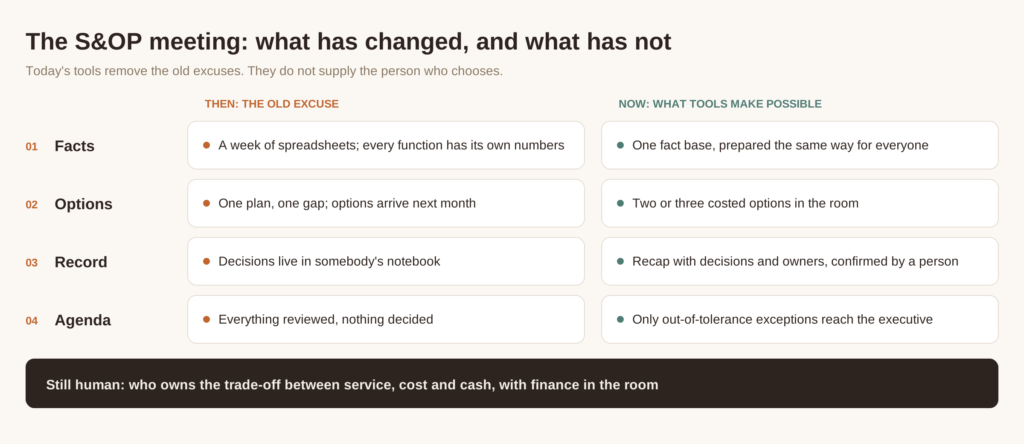
The first excuse was the facts. Today, an assistant connected to planning and financial data can prepare variance explanations, gap summaries and forecast bias by source. It does so before the meeting, the same way every month and for every function.
Speed is not the main gain. The gain is that one method applied to everyone removes the “my numbers” defence. When sales, operations and finance read the same explanation of the same gap, the meeting can start where it used to end.
This is also where the value of AI in planning actually sits today. BCG’s 2026 research on supply chain planning finds that most of it comes from foundational uses such as forecasting, exception management and data interpretation, not from lights-out planning.
There is a limit. A summary is only as neutral as its definitions. Someone has to own what counts as forecast accuracy, available capacity or a confirmed order. That ownership is governance work, and an assistant cannot do it.
Scenario planning is now cheap enough to bring options instead of a gap
The second excuse was the single plan. The old pattern was familiar. The meeting saw a gap and asked the planners to come back with options. The options arrived a month later, after the gap had changed.
Planning tools can now cost two or three options before the meeting starts. Add an overtime shift. Re-sequence two product families. Pull a purchase forward. Accept a lower service level for one customer group for six weeks. Each option arrives with its effect on service, cost and cash.
That changes the question in the room. It is no longer “whose number is right?” but “which cost do we accept?”. Only an executive can answer that question, so priced options expose an ownership gap instead of hiding it behind a data debate.
The decision record can now write itself
The third excuse was memory. Collaboration tools now produce a recap of a transcribed meeting with its discussion points, decisions and action items, often within minutes of the meeting ending.
Treat that recap as a draft. A suggested owner is not an owner until a person confirms it, and a decision the tool missed is still a decision. Someone in the room should check the recap the same day.
The habit that turns the record into accountability costs five minutes. Open the next meeting by reading back last month’s decisions and asking which were carried out. It is the same read-back and decision log that makes any agenda work.
Thresholds let only the exceptions reach the executive table
One more change is less about tools and more about design. Gartner recommends assessing S&OP on process adherence and meeting effectiveness, not only on business outcomes. A meeting that reviews everything cannot be effective, however good the data.
Agree tolerances in advance. A deviation inside the tolerance is handled in the demand or supply review. Only a deviation outside it reaches the executive meeting, with its options priced. The executive agenda shrinks to the choices that genuinely need an executive.
The same tolerances become important as AI agents start adjusting plans on their own. Limits written for people can govern software too, provided someone has written them.
No tool supplies the person who chooses
Better facts, priced options and an automatic record remove the reasons S&OP used to give for not deciding. They do not create the decision. Somebody still has to own the trade-off between service, cost and cash. That person needs the authority to make it, and finance has to be in the room.
That is the old S&OP lesson, and it applies to any forum: a steering committee that only receives status is not steering anything. The tools have made that easier to see, not easier to escape.
When the facts are agreed, the options are priced and the record writes itself, an S&OP meeting that still decides nothing is telling you something about who is in charge.