

The review is booked for sixty minutes, and the meeting agenda in the invite lists six items. The decision the sponsor needs sits at number six. At minute fifty-two the room is still on item two: a status update that grew a debate, which grew a story about a supplier from last year. Someone glances at the clock and says the line every organisation knows. Let’s take the rest offline.
“Offline” means the decision moves to a corridor, an email thread or the next meeting. The next meeting will open with the same status update. Nobody behaved badly. Nobody was rude, and nobody talked for the sake of it. The hour simply drained away, one reasonable contribution at a time.
I have watched this happen in boardrooms and on video calls, in organisations run from several countries, with boards in their sixties and project teams in their twenties. The style of the drift changes with the room. Some teams drift through politeness, some through debate, some through slides. The drift itself does not change.
That is the useful observation. If meetings overrun whatever the culture, culture is not the cause. Two structural gaps are: nobody in the room holds an explicit mandate to spend its time, and nobody can see the clock. Close those two gaps and the agenda starts to hold. Leave them open, and no amount of meeting etiquette will rescue item six.
An agenda item without an outcome is an invitation to talk
Most agendas list topics: “Supplier update”. “Budget”. “Q3 plan”. A topic tells people what to talk about. It does not tell them when they are finished, so they stop when the time runs out — which is exactly the problem.
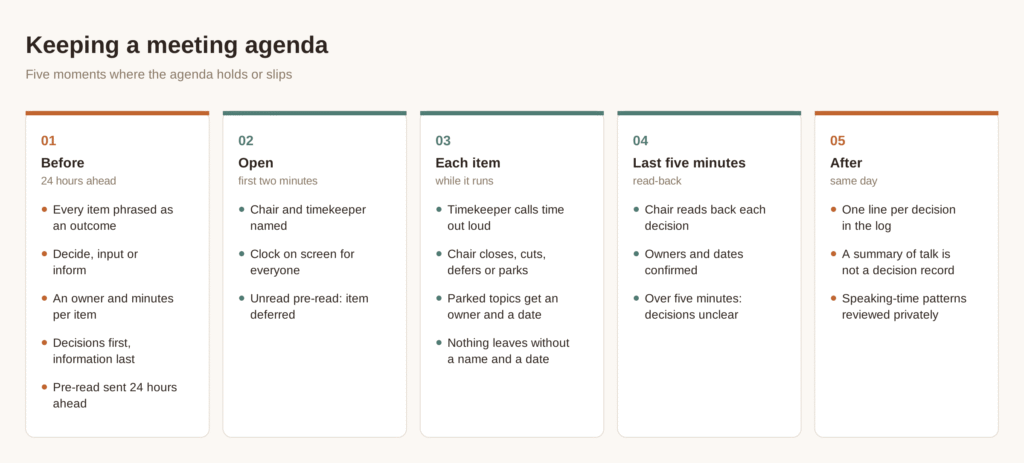
Rewrite every item as an outcome of one of three types. A decide item ends with a decision. An input item ends with the owner holding the views they asked for. An inform item ends with people knowing something. Give each item a named owner and a number of minutes. “Decide: approve the revised go-live date — programme manager — 15 minutes” tells the room what has to exist at the end, and when the end is.
Then put the decisions first and the information last. An inform item can move to a written note when time runs short; a decision cannot. Ordered this way, a ten-minute overrun eats an update rather than a decision.
The paperwork goes out 24 hours ahead, with one rule attached: if nobody has read the pre-read, the item is deferred, not presented. Reading a paper aloud to people who did not open it is the most expensive way to share a document. The rule feels harsh the first time it is applied. By the third meeting, people read.
The chair holds a mandate over the room’s time — or nobody does
Many meetings have an organiser but no chair. The organiser booked the slot and sent the invite. Nobody was given the right to stop a senior colleague mid-sentence — and that right is the whole job. Without it, the agenda belongs by default to the most senior voice in the room, or to the most persistent one.
Separate the chair from the timekeeper. The timekeeper calls time, neutrally and out loud: “five minutes left on this item”. The chair decides what happens next. Keeping the roles apart matters, because a chair who also polices the clock turns every intervention into a personal one. The first two minutes of the meeting name both roles and put the clock where everyone can see it.
When an item runs out of time, the chair has four moves. Close it: decide now, with what the room has. Cut it: stop the discussion and name who decides. Defer it: to a named date in a named forum. Park it: on a parking lot where every topic has an owner and a date, because a parking lot without owners is a bin.
One rule ties the four together. No item leaves the room without a name and a date — either a decision, or “she decides by Friday”. It is the same line that separates a steering committee that steers from one that receives status, applied to every meeting on the calendar.
A visible clock takes the personal edge off timekeeping
Interrupting someone is far easier when the clock does it. In a meeting room, a wall clock does the job. On a video call, nobody sees time passing unless someone puts it on the screen.
Most organisations already pay for tools that do this, and leave them unused. My own work runs largely remote-first, which is why the remote-first operating rhythm I agree at the start of an engagement covers how meetings run, not only when they happen. A starter kit worth testing for a month:
- An agenda the software can read. Put it in the invite or in the meeting notes. Teams’ Facilitator agent finds an agenda in either place and shows it as a timer on the meeting stage. Switching it on needs a Microsoft 365 Copilot licence.
- A timer on stage without Copilot. Several apps in the Teams store put a countdown or a timed agenda on the shared stage, and some let you hand control to a named timekeeper.
- Shorter defaults. Outlook can end every new meeting early, with separate settings for meetings under and over an hour. Twenty-five and fifty minutes become the norm.
- A look back, not a live meter. At the time of writing, Teams shows no live talk-time counter per person. After the meeting, the recap’s Speakers view shows who spoke and when, with a Teams Premium or Copilot licence.
No independent ranking of these tools is worth quoting; most “best meeting timer” lists come from vendors of a rival product. Test two options and keep the one people stop noticing. And note what the AI option does: it times an agenda, it does not hold the mandate to end a discussion. Software can be the timekeeper. The chair is still a person.
Speaking-time data works as a mirror, not as a weapon
Some teams want a live counter for every participant. In a stand-up or a round of updates, a fixed timebox per person works well. In a decision meeting, a public counter becomes a scoreboard, and people start performing for the meter rather than for the decision.
Use the data afterwards, and privately. One meeting proves nothing; five meetings show a pattern. The pattern is nearly always the same: the most senior person in the room speaks the most. A speaking-time review only works if it covers the sponsor as well, so ask the sponsor to be the first one measured.
What does differ between cultures is who speaks, not whether the hour runs out. In some rooms the quietest people hold the most useful information and will not volunteer it. A short round before the open discussion — two minutes each, in a fixed order — gets their view into the room before the loudest voice has framed the question.
What leaves the room matters more than what happened in it
Reserve the last five minutes of every meeting. The chair reads back each decision, its owner and its date, and the room confirms or corrects. If the read-back takes longer than five minutes, the decisions were not clear in the first place — and it is far cheaper to find that out now than in next week’s status update.
The read-back goes into a decision log on the same day: one line per decision, with date and owner, in one place everyone can find. AI-generated notes help with the capture. They do not replace the confirmation, because a summary of what was said is not a record of what was decided.
None of this is etiquette. A meeting that keeps its agenda is the smallest working unit of strategy execution: it turns a calendar of meetings into a cadence of decisions.
Item six gets decided in the room, or it gets decided by default.