


Most project health checks treat sponsorship as one factor among three. In practice it sets the ceiling for all the others. And the thing they all exist to deliver, value, is rarely scored at all.
A typical project health check asks whether the plan is current, whether the sponsor is engaged and whether people are ready for the change. Each answer gets a score, someone adds up the scores, and the total goes into the steering pack. The format is familiar and useful. It also hides two things that decide whether the change will hold.
Three equal pillars is a comfortable fiction
The best-known version of this idea is a triangle. The Prosci Change Triangle places leadership and sponsorship, project management and change management around a shared centre of success. As a way of saying that a change needs all three, it works. I have used it, and it opens conversations that a Gantt chart never will.
The trouble starts when the triangle turns into a scorecard. Three sides become three scores, and three scores invite an average. A strong plan and a well-run change team can then make up for a weak sponsor, at least on paper.
In practice they cannot. It is a familiar pattern: a programme reports green on every workstream for months while the decisions that matter sit unmade. The plan is sound and the training is booked. Nobody with enough authority is willing to choose between two directors who want different things.
Mandate sets the ceiling, not a share of the score
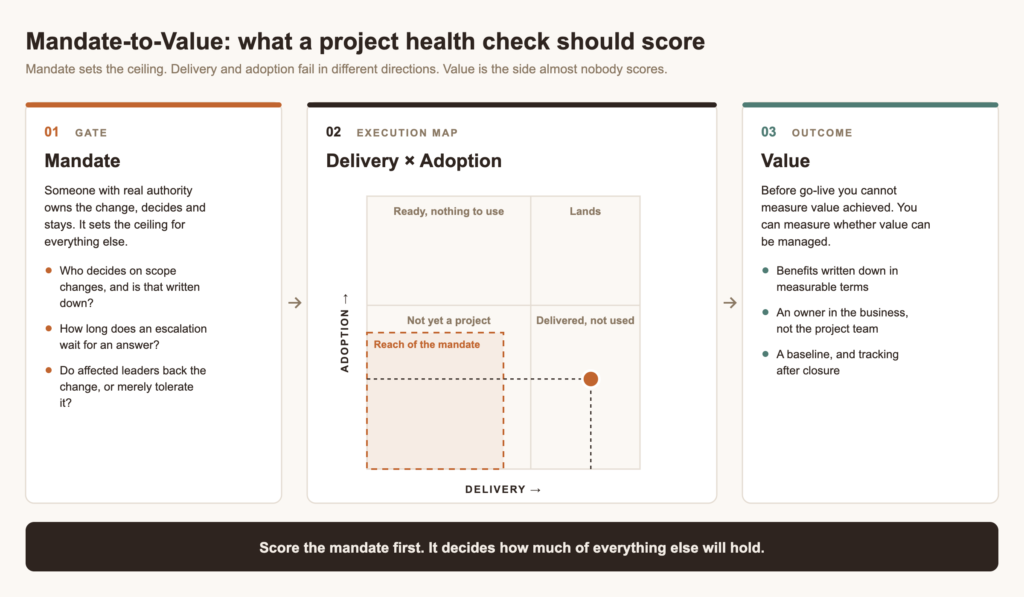
Mandate is the authority to decide about the budget, the people and the processes a change touches. It is not one ingredient among several. It decides how much of the work done everywhere else can survive.
Consider what happens when delivery runs ahead of authority. The team designs a new process, builds the system and trains the users. Then the first conflict arrives: a plant manager refuses to release key users, or a business unit wants an exception. If the sponsor cannot settle it, the work stalls. Usually the organisation drifts back to the old way and quietly writes off the delivery effort.
That is why I treat mandate as a gate rather than a pillar. Everything built beyond what the sponsor can enforce is at risk, however good the work.
The questions that test this are not about engagement or visibility. Who decides on scope changes, and is that written down? How long does an escalation wait for an answer? Do the leaders of the affected areas back the change, or merely tolerate it? I have made the same argument about PMOs: a charter that defines decision rights matters more than the person appointed to run the office.
A weak mandate is not a reason to stop. It is a reason to fix the mandate first, before spending more on everything that depends on it.
Delivery and adoption fail in different directions
The second problem with a single score is that it blends two things that fail in opposite ways. Delivery asks whether the solution is defined, planned, resourced and honestly reported. Adoption asks whether the people whose work changes are ready, able and actually using it.
A project can be strong on one and weak on the other, and the two patterns look nothing alike. Strong delivery with weak adoption gives you a go-live on time, followed by workarounds and a slow return to the old spreadsheets. Strong adoption with weak delivery gives you people who are ready and waiting for something the plan cannot yet deliver. Their enthusiasm turns into cynicism within a quarter.
Average the two and both cases score as fragile. The number is the same, but the cure is completely different. One needs attention on line managers and usage measures. The other needs scope, a plan and committed people.
So I stopped adding them up. Delivery and adoption work better as two axes of a map, with the mandate drawn as a box on the same map. A project’s position tells you which problem you have. Whether it sits inside the box tells you whether the sponsor can hold what has been built.
Value is the side almost nobody scores
The triangle is about getting a change to land. It says little about whether the change was worth making. Most health checks follow suit: they score readiness to go live and stop there.
Before go-live you cannot measure value achieved. You can measure whether value can be managed. Are the expected benefits written down in measurable terms? Does each one have an owner in the business, not in the project team? Is there a baseline, so improvement can be shown rather than claimed? Will anyone track the benefits once the project closes? These are core practices in PMI’s Benefits Realization Management guide and in AXELOS Managing Benefits.
Both frameworks make a point that ties value back to adoption. Benefits come from people working differently, not from a system going live. A project with a polished benefits register and low adoption is therefore not in good shape on value. It holds a set of numbers that will not arrive, and nobody will notice until the review a year later.
The most useful finding is often the disagreement
Any self-assessment has an obvious weakness: people score their own work kindly. The fix is not a more elaborate questionnaire. Ask different people the same questions separately and compare the answers.
The sponsor, the delivery lead and two or three line managers of affected teams will rarely agree. When the sponsor scores decision rights a four and the line managers score them a two, the gap is the finding. It means the sponsor believes something is settled that the organisation has not felt. That is worth an hour of a steering meeting more than any status colour.
I have turned this model into a free self-assessment, so you can try it on a project of your own. It runs in your browser, and your answers never leave it.
Score the mandate first. It decides how much of everything else will hold.