


A friend calls with good news and a question. They are getting married, and they would like you to be their best man. You say yes before they finish the sentence. It is an honour, and you have been to dozens of weddings. Then, somewhere between the call and the first planning dinner, a quieter thought arrives: what exactly does a best man do?
You know the visible parts: the rings, the speech, a signature at the registry. You suspect there is more, most of it before the day itself. Nobody has handed you a list.
Being named sponsor of a project feels much the same. The role arrives as a line in steering committee minutes, a name in a draft charter, or a nod across the table when someone asks who will take this on. It is a compliment to your seniority. It almost never comes with a briefing.
The gap matters more than it does at a wedding, because a sponsor is not a guest of honour at someone else’s project. A project sponsor’s job is to decide whether the work should exist, own the benefit it is meant to deliver and back the project manager at every stage, and the most consequential part of that job happens before the project formally exists. The tool for doing it well is not a dashboard. It is a working relationship with the project or programme manager.
What follows is the job, stage by stage.
The most important sponsor work happens before the project exists
Most projects are decided long before anyone writes a charter. An idea surfaces in a strategy session, a customer complaint or a budget round, and it gathers momentum. By the time a project manager is appointed, the solution is often fixed and the original problem half-forgotten. This early stage is where a sponsor adds most value, and where most sponsors are absent.
The first question is whether the work should exist at all. PMI’s guidance on benefits realisation makes the point that work should begin from identified benefits rather than from a preferred solution. A sponsor who can describe the problem, the expected benefit and how anyone would notice it has already done more for the project than any later steering meeting will.
The business case is yours. Others may draft it, but you answer for it, so read it as if you will defend it to the board a year from now. You probably will. Check that the work fits the strategy, and that something else has to make room for it. A portfolio with a working intake gate will ask you these questions anyway; without one, you have to ask them of yourself.
Last, and most uncomfortable: check your calendar. Sponsorship needs regular time across the whole life of the work. If you cannot give it, the honest moment to say so is now, not halfway through.
Initiating: your signature on the charter is a commitment, not an autograph
The eighth edition of the PMBOK Guide describes five focus areas: Initiating, Planning, Executing, Monitoring and Controlling, and Closing. It treats them as needs every life cycle has to meet rather than as rigid phases. Initiating is where the sponsor’s role becomes formal, and three things deserve your full attention.
The first is the choice of project or programme manager. You are not hiring a reporter. You are choosing the person you will depend on for months or years, so take part in that decision.
The second is the mandate. Agree in writing what the manager may decide alone, the tolerances on cost, time and scope beyond which a decision comes back to you, and the route for anything bigger. This is the most useful page in the project file, and it is often missing. Without it, either every question becomes an escalation or none of them does.
The third is the benefits. Name them in the charter, together with whoever will measure them. If the expected benefit is not in the authorising document, nobody will be held to it later, and every claim of success becomes impossible to test.
Then secure the people. Resource commitments made in a meeting fade within a month. Ask the line managers who hold those people to confirm them, and keep the confirmation.
Planning: challenge the plan before you approve it
A plan arrives looking finished, with dates, phases, a budget and a risk register. The temptation is to approve it because it looks professional and the team has worked hard on it.
Approve it only after you have asked the questions nobody else in the room will. Which assumptions, if wrong, would break this plan? What does the team expect to go wrong first? Where is the contingency, and who controls it? What will we stop doing to make room for this? A sponsor who asks these questions at the planning stage rarely has to ask harsher ones later.
Planning is also when you agree how the two of you will work. Settle the cadence: how often you meet, what goes to a steering meeting and what does not, and how quickly you commit to decisions. Agree that one honest conversation beats three polished reports. Map the stakeholders together, too. Some doors in the organisation open only for you, and the plan should say which ones you will open and when.
Executing, monitoring and controlling: decide fast, show up, protect
During delivery, the sponsor’s work narrows to a few things done reliably.
Decide fast. A decision the project needs this week and receives next month is often worse than an imperfect decision on time. If you cannot decide, say who can, and by when.
Show up. Change management research, Prosci’s included, consistently ranks active and visible sponsorship among the strongest contributors to success. Visibility does not mean attending every meeting. It means being seen, at the right moments, backing the work and the people doing it.
Protect the resources. Other priorities will reach for your project’s budget and people. Defending them is your job rather than the project manager’s, because only you have the standing to say no to a peer.
Keep the money case honest. The eighth edition of the PMBOK Guide now treats finance as a performance domain in its own right, distinct from cost control. The question behind it belongs to the sponsor: does the case for this work still hold? A project can sit on budget while its benefit quietly evaporates. When that happens, the most valuable thing a sponsor can do is propose stopping, and a steering committee that actually steers is where that proposal belongs.
Closing is not the end of sponsorship
A project closes when its outputs are delivered and accepted. The benefits rarely arrive on the same day. A new system goes live; people still have to use it; the savings appear a year later, if at all.
Accept the deliverables formally, and make sure the project really closes: team released, budget closed, lessons recorded. Then stay a little longer. PMI’s benefits guidance describes a sustain stage that runs largely after the project has ended, and that is where many benefits are lost. Before you step back, hand responsibility for realising them to a named manager in the line organisation, with a date to check whether they arrived.
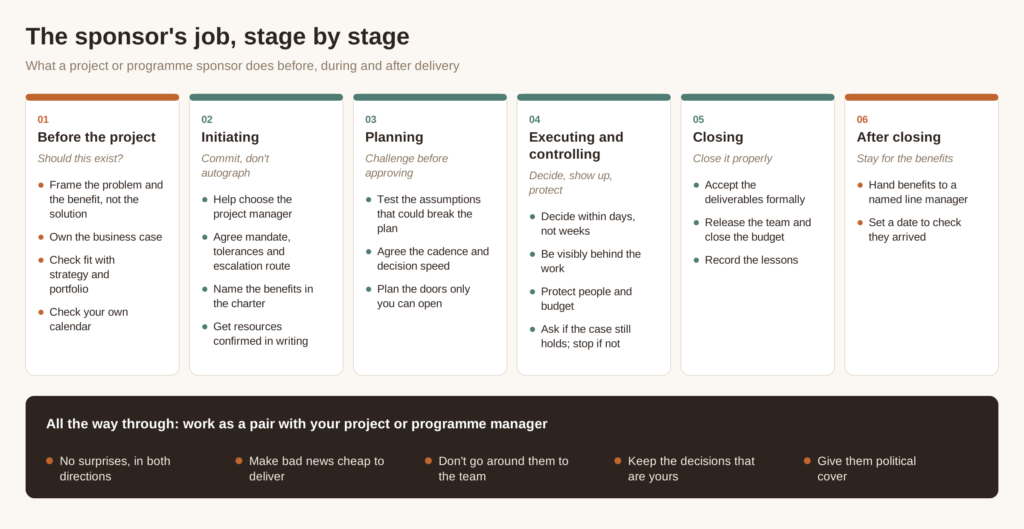
The sponsor and the project manager are a pair, not a chain of command
Everything above runs through one relationship. A healthy sponsor and manager look less like a reporting line and more like two people who need each other to succeed.
Agree on no surprises, in both directions. The manager tells you early when something is going wrong; you tell them early when the organisation’s priorities are shifting. Make bad news cheap to deliver. A sponsor who reacts badly to the first red status will only ever see green ones.
Stay out of the shortcut to the team. Ask your questions through the manager, or with them in the room. Every bypass weakens the person you depend on.
Keep the decisions that are yours. When the manager escalates, the question is now yours to answer. Sending it back with “use your judgement” turns their mandate into a liability.
Give them political cover. The manager will have to tell senior colleagues things they would rather not hear. Make it known that they do so with your backing.
The PMBOK Guide counts accountable leadership among its principles. In practice, that accountability is shared across this pair: the manager answers for delivery, and the sponsor answers for the reasons the delivery matters.
Six ways sponsors fail without noticing
None of the common failures feel like failure from the inside. They feel like being busy, being supportive or being efficient.
- The figurehead. Signs the charter, opens the kick-off, then appears only when something is already red.
- The committee. Sponsorship shared among three executives, so every decision needs all three and none of them answers for it.
- The absent, then alarmed. Silent for months, then demanding a recovery plan by Friday.
- The shadow project manager. Runs the work personally, sidelines the manager, and leaves nobody watching the business case.
- The forwarder. Sends every question about scope and priority to the PMO and treats its reply as the decision, although sponsorship cannot be delegated to the PMO.
- The silent handover. Moves to a new role mid-project and passes sponsorship on in a single email, with no briefing on what was promised to whom.
Each has a simple corrective, and most of them are in the stages above.
A good best man is mostly invisible on the day, because the work happened earlier: plans checked, people briefed, the rings in the right pocket. Sponsorship works the same way. Nobody remembers the sponsor whose project arrived as planned; everyone remembers the one who forgot the rings.