


Sustaining project outcomes beyond the initial implementation phase is a persistent challenge for organizations. Without an effective system to oversee and reinforce changes, improvements risk regression, leading to inefficiencies and lost value.
Key barriers to sustainment include:
- Lack of visibility into adherence to new processes
- Reactive instead of proactive issue management
- Weak reinforcement of behavioral changes
- The absence of a structured governance model
To tackle these challenges, organizations require an integrated and structured framework to maintain improvements. A proven method is to utilize the Obeya or War Room.
Obeya: Origins and Purpose
Derived from lean manufacturing principles, Obeya (Japanese for “big room”) was developed by Toyota as a collaborative hub for decision-making and oversight. It centralizes essential project information and encourages cross-functional engagement to ensure that ongoing improvements are sustained.
The key benefits of Obeya include:
- Alignment: Facilitates synchronization across leadership, managers, and execution teams
- Visibility: Provides a real-time, structured review of key performance indicators (KPIs)
- Continuous Improvement: Drives problem identification and resolution before escalation
- Accountability: Reinforces ownership and commitment to sustainment objectives
Daily Obeya Use for Sustainment
To ensure project outcomes remain effective long-term, Obeya is a central hub for tracking daily performance, quickly resolving problems, and continuously reinforcing employees.
Daily Stand-Ups and KPI Review
- Regular meetings with project leads, managers, and functional teams
- Review of KPIs, process adherence, and sustainment goals
- Identification of potential risks and deviations, with corrective actions logged
Issue Escalation and Resolution
- Immediate identification of process inefficiencies or resource constraints
- Structured A3 problem-solving approach to prevent escalation
- Governance model for executive intervention when required
Reinforcement of Behavioral and Cultural Shifts
- Visual management tools highlight expected behaviors and achievements
- Recognition of compliance and corrective coaching when needed
- Continuous feedback loops to embed new standards
Cross-Functional Collaboration for Adaptation
- Integration of different departments to ensure alignment
- Agility in adapting to market changes while maintaining sustainment
- Formalized process updates based on lessons learned
Governance and Continuous Improvement
- Weekly/monthly governance reviews to monitor sustainment efforts
- Post-implementation audits to track impact and refine processes
- Feedback mechanisms to inform future transformation projects
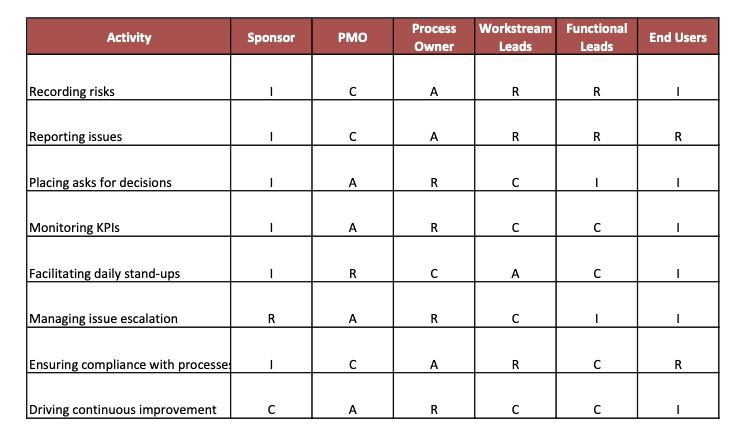
Obeya RACI: Roles and Responsibilities
A clear RACI (Responsible, Accountable, Consulted, Informed) framework ensures structured ownership within the Obeya process.
Virtual Obeya: Establishing a Digital War Room
With remote and hybrid work models becoming prevalent, a Virtual Obeya ensures consistent collaboration and oversight. Here are three implementation options:
Collaboration Platform-Based Obeya
-
- Utilize Microsoft Teams, Slack, or Google Workspace for structured discussions
-
- Maintain a real-time dashboard for key metrics, risks, and action tracking
-
- Automate alerts and notifications to keep stakeholders engaged
Kanban-Style Virtual Obeya
-
- Use Jira, Trello, or Monday.com to create an interactive workflow
-
- Assign responsibilities and track progress via automated workflows
-
- Integrate with Power BI/Tableau to visualize sustainment trends
Immersive VR Obeya
-
- Deploy VR platforms like Spatial, Glue, or Horizon Workrooms for an immersive experience
-
- Enable real-time discussions and interactive whiteboards
-
- Foster engagement for distributed teams through virtual collaboration tools
Each approach offers varying levels of engagement and accessibility, depending on an organization’s needs and technological infrastructure.
Conclusion: Ensuring Long-Term Success Through Obeya
The Obeya approach fosters an environment where accountability, transparency, and continuous reinforcement drive sustained project outcomes. Rather than relying on static reporting, the War Room remains a dynamic control center, ensuring improvements are embedded into daily operations.
However, organizations must be aware of factors that cause Obeya to fail, including:
- Lack of Active Sponsorship: Without executive leadership, the Obeya becomes a passive tool rather than a proactive decision-making hub.
- Inconsistent Attendance: Failure to enforce 100% daily participation weakens alignment, engagement, and sustainment efforts.
By integrating Obeya into daily workflows, organizations maximize long-term impact, ensuring project benefits are not just achieved but sustained over time.