

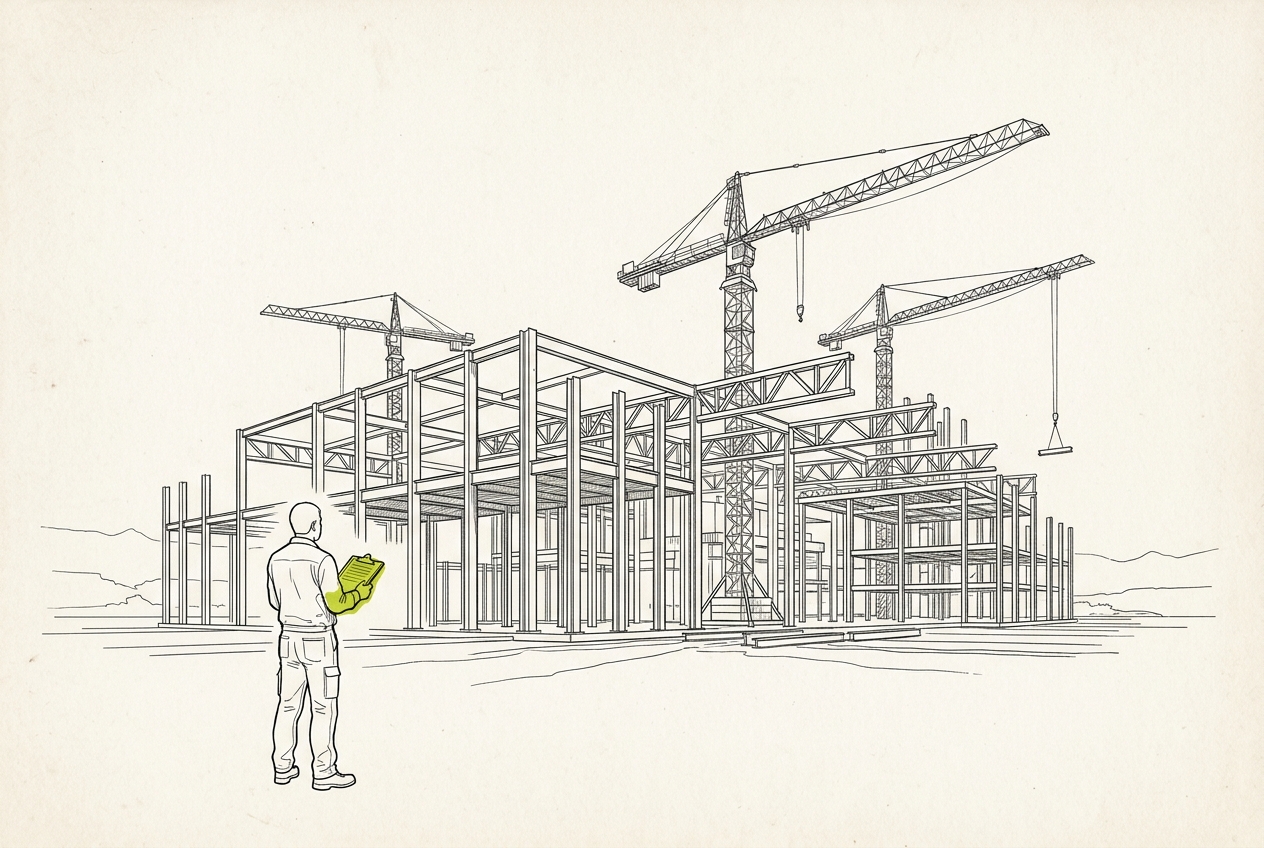
The interface milestone slips for the second time in six weeks. The evidence is clean: dated photographs, a signed inspection report, an email trail showing the owner’s team told the contractor twice. Everything a project manager would need to act.
Except acting is not the job. The programme belongs to the main contractor. The person holding the evidence works for the owner. They have no crew to redirect, no budget line to hold back, no schedule to rewrite. They write the escalation, and then they wait.
Nothing happens for three weeks. Then something does. The escalation didn’t force it—the contractor’s own schedule finally made the slip impossible to ignore. The report was accurate from day one. Being right early made no difference to when the fix arrived.
That gap, between being right and being able to act, is not a personal failure. It is the entire shape of a role that organisations hire constantly and understand rarely: delivery assurance.
What delivery assurance actually consists of
Delivery assurance is not a lighter version of project management. It runs on a different toolkit, and that toolkit has nothing to do with directing work. It exists to make a record that nobody can later dispute:
- Evidence trails — dated, verifiable documentation of what was agreed, what was delivered, and where the two diverge.
- External review follow-up — checking that the responsible party actually closed a third-party inspection’s findings, not merely acknowledged them.
- Interface mapping — tracking every point where one party’s scope depends on another’s, since that is where blame turns circular fastest.
- Structured escalation — a defined path and timeline for raising an issue, so a comment made in a meeting never has to stand in for a decision.
None of these instruments touch the work itself. Between them, they answer one question with total precision, months after anyone would otherwise remember: who knew what, when, and what was done about it.
That precision is the entire product. Organisations judge a project manager on outcomes. They judge delivery assurance on whether the record was complete and timely enough that nobody can later rewrite what actually happened.
The difference between assurance and delivery
Owning delivery means holding the levers that actually move a programme: reallocating people, reprioritising work, changing a supplier, saying no to scope. Execution leadership is built entirely from levers like these — cadence, portfolio, performance, all in service of making an approved plan real.
Delivery assurance holds none of them. It sits outside the delivery organisation by design. That distance keeps its evidence and its judgement free of a stake in the outcome. That independence is the role’s entire value. It is also the reason the role cannot do the thing people keep expecting it to do.
The temptation to fix it yourself
Every experienced assurance professional reaches the same moment eventually: the fix is obvious, the contractor is slow, and it would be faster to just pick up the phone and sort it directly.
Doing that once feels harmless. Doing it twice makes you a shadow project manager with no formal standing, and it costs the one thing the role actually depends on. The moment you start directing outcomes informally, your evidence stops being independent. Everyone in the room knows it, even if nobody says so.
The discipline is staying on the assurance side of the line precisely when crossing it would be quicker. That is a harder skill than it sounds, and few job descriptions ever mention it.
Its one hard limit
Delivery assurance can document. It can escalate. It cannot compel.
Say this plainly, and say it early. The alternative is worse: an assurance function quietly blamed, months later, for an outcome it never had the power to prevent. Blame lands on the person who saw the problem first and said so loudest. That is precisely backwards, and it is precisely what happens when nobody names the limit up front.
The organisational honesty this requires
An escalation path only has value if something is on the other end of it. Say someone raises the same issue three times and nobody resolves it once. That is not a weak assurance function. That is a sponsor who has been told, repeatedly, and chosen not to act — and the escalation log is now evidence of that choice, not of the function’s failure.
Reading it that way takes a kind of organisational honesty most companies don’t practise. Asking for a better dashboard is easier than admitting the sponsor was never going to act on what the old one already showed. A dashboard cannot fix a decision nobody intended to make.
The healthiest programmes treat every assurance finding as an input to an actual decision. Someone with the standing to decide acts on it, on a timeline agreed in advance. Everything short of that turns the function into expensive paperwork that happens to be accurate.
What this means for whoever is hiring the role
None of this is the hired person’s problem to fix alone. It starts with the brief.
Write down, before anyone fills the role, exactly which decisions it can make, which it can only recommend, and which sit entirely with someone else. That is the same reserved-decision discipline that belongs in any mandate — applied here to a role that is unusually easy to under-specify. Then commit, in writing, to a maximum time between an escalation landing and someone with authority responding to it. An unanswered escalation is not a delay. It is a decision, made by default, that the issue does not matter enough to act on.
Sponsors who skip this step get a function that looks identical from the outside — same reports, same evidence trails, same vocabulary. That holds right up until the first real conflict, when the absence of a defined answer becomes everyone’s problem at once.
Why it keeps getting hired as if it were project management
Job specs for these roles borrow project-management language, because that is the vocabulary everyone already has to hand. The brief says “manage the interface,” “own the schedule risk,” “drive contractor performance” — verbs that describe direction, not oversight.
The person hired against that brief arrives expecting a role with levers. They discover there are none, and they spend the first month wondering whether they were misled.
Nobody quite lied. Someone reaching for the only vocabulary available wrote the brief, describing a role nobody had bothered to define on its own terms.
Delivery assurance was never a smaller job than project management. It was always a different one — and naming that difference is what keeps the blame where it actually belongs.