


A training plan written for a new manager in week one is usually a confession that the selection went wrong.
A manager hired in 2027 should arrive able to prioritise, allocate people and money, close decisions and run a digital working day unaided, and the onboarding plan should teach your organisation, not the fundamentals. Those are the manager skills a COO can test before signing, and they are less glamorous than the debate about AI and leadership suggests.
A training plan for the basics is a selection error with a budget
Picture the moment a COO replaces a manager. The outgoing one leaves a team, a backlog and a set of half-made decisions. The incoming one arrives with a strong interview, a good CV and, within a fortnight, a development plan: a prioritisation workshop, a course on difficult conversations, a session on the planning tool.
Each item sounds reasonable. Together they say something uncomfortable. The organisation hired someone who cannot yet do the job, and it has decided to pay for the gap rather than name it.
The research does not favour that route. Gartner reports that the average manager already carries 51% more responsibilities than they can handle, and its research finds that making the role doable, with fewer and clearer responsibilities, does far more for manager effectiveness than more training. A training plan adds hours to a role that is already over capacity. It rarely fixes either problem.
So the useful question for a COO is the reverse of the usual one. Not “what will we teach the new manager?” but “what must they already do on day one, so that onboarding can be about us?”
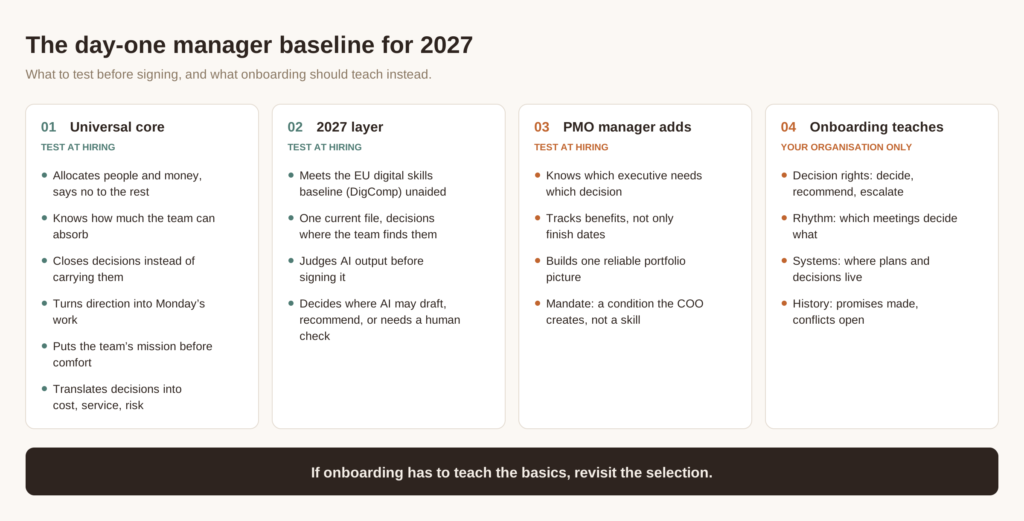
The universal core of management is operational, not inspirational
Most competency models start with vision, inspiration and emotional intelligence. Gartner’s latest manager research goes the other way. In April 2026 it advised HR leaders to build manager selection and training around the operational parts of the role. It named four fundamentals: moving people and money to where they matter most, protecting the team’s capacity, building AI into the work, and helping people grow their careers. Its survey of 2,947 employees and managers also found that managers who put performance first are more likely to hit their goals.
That list is close to what a COO actually needs. Translated into what a new manager must already do on day one, the universal core looks like this:
- Allocate. Decide where people and money go this week, and say no to the rest.
- Protect capacity. Know how much the team can absorb before quality drops.
- Close decisions. Settle them, rather than carry them from meeting to meeting.
- Translate direction. Turn a direction from above into work the team can start on Monday.
- Put the mission first. Serve the team’s goal, not only the team’s comfort.
- Read the money. See how a team decision lands on cost, service and risk.
None of this is new, which is the point. These skills were universal thirty years ago and will be in thirty years’ time. They are also where leaders feel weakest. In DDI’s Global Leadership Forecast 2025, leaders rated setting strategy and managing change as their two biggest gaps, while only 22% of HR functions prioritised them. For a line manager, “setting strategy” mostly means translating the approved one into priorities, not inventing a new one.
A manager who shields the team from the business is not doing the job
Here the data becomes uncomfortable. In the same Gartner survey, 66% of managers said managing people is their primary responsibility, ahead of moving the organisation towards its goals. Sixty-two per cent felt obliged to protect their teams, and 45% admitted to decisions that favoured employees over the business.
Protecting a team sounds like good leadership, and sometimes it is. A manager who absorbs a badly timed request, or argues for a realistic deadline, earns trust that pays back many times over. The trouble starts when protection becomes the job description. Bad news stops travelling upwards, poor performance goes unaddressed for a year, and the team’s comfort quietly outranks the plan it was hired to deliver.
Gartner’s own recommendation is blunt: move a manager’s first loyalty from individual employees to the team’s collective mission. That is not a licence for coldness. Fairness, clear priorities and recognition stay non-negotiable, and they are exactly what employees say they miss. In the same survey, only 41% of employees said their manager helps them prioritise their work.
For a COO, this is the most revealing question in the interview. Ask the candidate about the last time they told their team something it did not want to hear, because the business needed it. A good manager has an answer ready. A manager who mainly shields the team usually does not.
Business acumen is the skill everyone assumes and almost nobody checks
The second gap is quieter. Business acumen is the ability to see how a team’s decision lands on cost, revenue, service and risk. PMI’s Pulse of the Profession 2025 found that only 18% of project professionals show high business acumen, against 66% at a moderate level. There is little reason to expect line management to look better, because hiring rarely tests it. Candidates talk about their team, their style and their achievements, and seldom about money.
Yet almost every managerial decision is a financial one wearing another name. Approving overtime is a trade between cost and service. Delaying a hire is a bet on workload. Accepting a customer’s rush order is a choice about margin and about the next customer’s delivery date.
A manager who cannot translate a team decision into cost, service and risk will either escalate everything or decide in the dark. Both are expensive. The interview test is simple: give the candidate one real trade-off from your operation, then ask what they would need to know to decide it, and whom they would tell.
The 2027 layer is a digital baseline, and Europe has already written it down
The layer that is genuinely new to this decade is where most job adverts go vague: “digital mindset”, “comfortable with technology”, “AI-curious”. It need not be vague. The European Commission already publishes a reference list of the digital skills every adult needs: the Digital Competence Framework, known as DigComp. It describes 21 competences in five areas: finding and evaluating information, communicating and collaborating, creating content, safety and responsible use, and solving problems. Its latest version, 3.0, builds AI into all 21 rather than treating it as a separate subject.
DigComp was written for every citizen, not for specialists, and that is precisely its value. It sets a minimum, not an expert profile. A manager in 2027 should clear that minimum without anyone’s help. Mapped onto a manager’s working week, the five areas mean:
- Information. Judges a source before forwarding it.
- Communication and collaboration. Runs a shared calendar that tells people something, and keeps decisions where the team can find them.
- Content creation. Works from one current version of a document, not from attachments.
- Safety and responsible use. Knows what must never be pasted into a public tool.
- Problem solving. Fixes a clumsy digital workflow instead of working around it.
Organisations that skip this layer end up running two companies. One works in shared channels and current files; the other waits for an email with an attachment. The habits that disqualify a project leader disqualify a line manager even faster, because the whole team inherits them.
AI judgement means knowing what not to sign
The AI part of the 2027 profile is smaller than the hype and harder than it looks. A manager does not need to build agents. They need to judge what the tools produce.
Teams already deliver AI-drafted reports, summaries and analyses that look finished. Some are excellent. Others are fluent, confident and wrong, and the person best placed to notice is the manager who signs them off. The skill is old-fashioned, and it comes down to three checks:
- Basis. What does this figure rest on?
- Spot check. Does at least one claim match its source?
- Sign-off. Has anyone verified it before it travels further?
That is why Gartner counts building AI into the work among the management fundamentals. The manager decides where a tool may draft, where it may recommend, and where a human must check. A candidate who talks only about the tools they use has missed the question. A candidate who talks about what they no longer accept unchecked has understood it.
A PMO manager needs all of this, plus three capabilities PMI now names
Everything above applies to a PMO manager. The role adds a layer, because a PMO’s customers are other managers and its product is better decisions, made sooner.
PMI’s 2026 research with more than 1,900 PMO and senior leaders identifies three capabilities that lift a PMO beyond operational delivery: a customer-centric approach, strategic alignment and value realisation, and data and technology integration. Each sounds abstract; in practice, each is a hiring test:
- Customer-centric approach. Knows which executive needs which decision, and when.
- Strategic alignment and value realisation. Tracks whether projects deliver the benefits that justified them, not only whether they finish.
- Data and technology integration. Builds one reliable picture of the portfolio instead of five competing spreadsheets.
There is one thing no candidate can bring, however strong. A PMO manager without a mandate from an executive sponsor runs a reporting service, not a portfolio. That is a condition the COO creates, not a skill the candidate lacks, and it belongs in a written charter before the hire, not in a training plan after it.
What belongs in the onboarding plan instead
None of this means a new manager should get no support. It means the support should be about the organisation, which only the organisation can teach.
A useful onboarding plan covers four things:
- Decision rights. What the manager decides alone, what they recommend, and what they escalate.
- Management rhythm. Which meetings matter, what each one decides, and what the manager must bring to each.
- Systems. Where plans, decisions and documents live, and who owns them.
- History. Which promises are already made, which conflicts are open, and who holds the informal knowledge.
That is four to six weeks of introductions, not a curriculum. If the list starts to include prioritisation, feedback, basic finance or how to run a calendar, it is the selection that needs revisiting.
The best sign you hired the right manager is a training budget you never had to spend on the basics.