

The quarterly strategy review closes on a decision everyone in the room supports: next year, the company will enter a new customer segment. The slide is clear, the minutes record the approval, and the next monthly integrated business planning meeting is three weeks away.
Six weeks later, the demand plan carries no volumes for the new segment. Nobody has opened a vacancy for the application engineers it will need. The capital request for the extra test line is not on any agenda.
Integrated business planning is one of several engines that turn an approved strategy into monthly decisions, and it works only when the strategy review feeds it and hears back from it. Without those engines, an approved strategy stays an approved document.
An approved strategy changes nothing until a recurring decision picks it up
A strategy review approves direction. Direction on its own moves nothing. It starts to matter when it becomes decisions with dates: volumes to plan, people to hire, capital to release, prices to set.
Those decisions are made in recurring cycles that every company already runs. Most of those cycles were designed before the current strategy existed, to run the business as it is. If the strategy never enters them, they keep making last year’s decisions, and they make them competently.
I spent the first decade of my career in supply chain and logistics functions of manufacturing companies. More than once, I learned about a new strategic priority from the demand plan rather than from anyone who had approved it. The volumes arrived before the explanation.
Every function already runs an execution engine
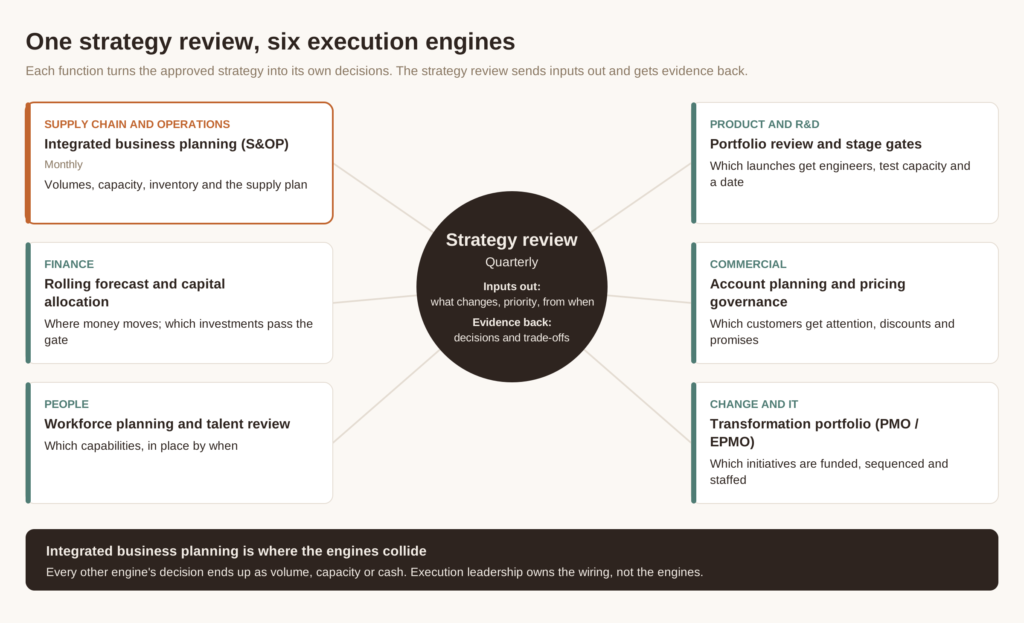
An execution engine is a recurring forum, with a fixed rhythm and a named owner, where a function commits its own resources to the direction it has been given. Most companies run at least six of them, under different names:
- Supply chain and operations: integrated business planning (S&OP). Monthly. Volumes, capacity, inventory and the supply plan that serves them.
- Product and R&D: product portfolio review and stage gates. Which launches get engineers, test capacity and a date.
- Finance: rolling forecast and capital allocation. Where money moves between the annual budget and the strategy, and which investments pass the gate.
- Commercial: account planning and pricing governance. Which customers and segments get attention, discounts and delivery promises.
- People: strategic workforce planning and talent review. Which capabilities the strategy needs, and when they have to be in place.
- Change and IT: the transformation portfolio. Which initiatives are funded, sequenced and staffed, usually through a PMO or an enterprise PMO.
None of these engines is new, and none needs inventing. What most companies lack is the wiring between them and the strategy review.
Integrated business planning is where the engines collide
Every other engine’s decision eventually becomes volume, capacity or cash. A new segment becomes demand. A product launch becomes capacity and inventory. A hiring plan becomes cost. A capital approval becomes capacity eighteen months later.
Integrated business planning is the one place where those consequences meet in a single plan, every month, with finance at the table. That makes it the natural integrator. The reason is not that planners are special. It is that everything the other engines decide eventually lands in the factory and in the cash position.
The label matters less than the job. Gartner frames the IBP versus S&OP debate as a question of decision alignment rather than terminology. That is the useful test: does the monthly cycle align decisions across functions, or does it only reconcile numbers? Supply chain is where I started. It is why I treat this cycle as part of execution governance and keep supply chain strategy and advisory next to PMO work.
There is a catch. Integrated business planning can integrate only what it is given. If the product review approves a launch without telling the planning cycle, the planning cycle discovers the launch as forecast error.
The strategy review is the hub, and the engines are its spokes
Two channels connect the hub to the spokes. The outbound channel is a short, explicit translation sent to each engine after every strategy review: what changes, with what priority, from when. It is a page per engine, not a strategy deck.
The return channel carries evidence back. Each engine reports what it decided, what it could not afford, and which trade-off it made to stay within its limits. This is the half most companies skip. Without it, the strategy review approves its own wishes quarter after quarter and finds out at year end which of them never happened.
The return channel is not a new report format. As with any reporting, the information follows the governance that produces it. What each engine sends back is its own decision record, not a status slide written for the occasion.
In the opening scene, the planning engine would have sent back one line within a month: no volumes planned for the new segment, because sales has not committed a forecast. That line would have reached the next strategy review while there was still time to act on it.
The calendar matters too. Hold the strategy review a week or two before an executive planning meeting. The first planning cycle after each review then becomes the first test of what was approved.
Execution leadership owns the wiring, not the engines
Each engine has a functional owner, and nobody should take it away from them. The COO or supply chain director owns the planning cycle. The CFO owns the capital gate. The HR director owns the workforce plan.
What no functional owner holds is everything between the engines: one source of inputs, a shared calendar, the return channel, and the escalation when two engines’ decisions collide. Sales promises the new segment a delivery date that the capital gate has just refused to fund. Somebody has to see that collision before the customer does.
That is the job of strategy execution as a discipline. It may sit with a chief transformation officer, a strategy execution lead or the CEO’s office. It does not rewrite the strategy, and it does not run the engines. It makes sure the approved strategy reaches all of them and that their evidence comes back.
A strategy that never reaches the monthly plan has not been executed. It has been approved.